
Article · Brandon Warrell
Florida cottage food label requirements, plus a layout checklist
A Florida cottage food label must show the operation's name and address, the product name, the ingredients, the net weight or volume, allergen information, nutritional information if you make a nutritional claim, and one required statement in at least 10-point type. All of this comes from Fla. Stat. §500.80(3). That text decides the label size, so get it final before design starts.
This is general information, not legal advice. Statute text checked against the 2026 Florida Statutes on November 4, 2026.
What must a Florida cottage food label include?
Section 500.80(3) says a cottage food operation may only sell products "which are prepackaged with a label affixed" that contains:
- (a) "The name and address of the cottage food operation."
- (b) "The name of the cottage food product."
- (c) "The ingredients of the cottage food product, in descending order of predominance by weight."
- (d) "The net weight or net volume of the cottage food product."
- (e) "Allergen information as specified by federal labeling requirements."
- (f) "If any nutritional claim is made, appropriate nutritional information as specified by federal labeling requirements."
- (g) The required statement, covered next.
The list says nothing more about the address, so ask the Florida Department of Agriculture and Consumer Services (FDACS) about a home address or PO box. It doesn't list a barcode either.
What exactly does the required statement say?
Item (g) gives the wording:
"Made in a cottage food operation that is not subject to Florida's food safety regulations."
Copy it from the statute instead of retyping it from memory.
How big does the type need to be?
The statement must be "printed in at least 10-point type in a color that provides a clear contrast to the background of the label." That's the only type size in §500.80. The section gives no contrast ratio and no placement, panel or share-of-label rule. Section 500.80(1)(a) also requires compliance with the applicable requirements of chapter 500, so ask FDACS whether other labeling rules apply to your type sizes or placement.
At 72 points to the inch, 10-point type is about 0.139 in. That's the type size, not the height of any letter.
The statement runs 90 characters, including spaces. Measured at 10 points from the font files, one line is about 4.9 in wide in Times New Roman, 5 in in Calibri and 5.3 in in Arial, so on a small label it has to wrap. Here's the approximate depth in those fonts with 12-point line spacing and no hyphenation:
| Column width | Lines | Depth, without margins |
|---|---|---|
| 1.25 in | 5 | 0.83 in |
| 1.5 in | 4 | 0.67 in |
| 2 in | 3 | 0.50 in |
| 3 in | 2 | 0.33 in |
These are calculated estimates, not a spec, and other fonts will differ.
Do you need a Nutrition Facts panel?
Under §500.80(3)(f), nutritional information is required if you make a nutritional claim. The section doesn't define "nutritional claim" and doesn't use the words "Nutrition Facts panel."
FDA's label claims page offers background: nutrient content claims "describe the level of a nutrient in the product," using terms such as "free, high, and low." Health claims link a food substance to reduced risk of a disease or health-related condition.
So check any wording that describes nutrition or health before you print. How federal rules apply to a cottage food label with no claim on it is a question for FDACS.
How do you list allergens?
Florida points to federal labeling requirements. FDA lists nine major food allergens: milk, eggs, fish, crustacean shellfish, tree nuts, peanuts, wheat, soybeans and sesame. The food source must be declared at least once, in one of two ways:
- In parentheses after the ingredient, such as "flour (wheat)" or "whey (milk)."
- In a "contains" statement immediately after or next to the ingredient list, such as "Contains wheat, milk, and soy."
The requirement is also met when the ingredient's common name already identifies the source, as with buttermilk. You also have to name the type of tree nut (such as almonds) and the species of fish or crustacean shellfish (such as cod or shrimp).
How do you fit everything on a small label?
These steps are design advice; the statute doesn't cover them.
- Start with final text. Write out every line, then choose the label size.
- Get the container size. Measure the labeling area, or ask your supplier for the container size or the dieline, the flat template that shows where a package is cut and folded.
- Put the product name first. Make it the largest line.
- Keep the required statement plain. Dark type on a plain light background is the simplest way to get strong contrast. Reversed type, foil or a busy pattern makes "clear contrast" harder to meet.
- Size for your longest ingredient list. If several flavors share a template, lay it out with the longest list first, and keep allergens right beside it.
- Size up if it won't fit. The section says nothing about splitting information between a front and back label, so ask FDACS before you do it.
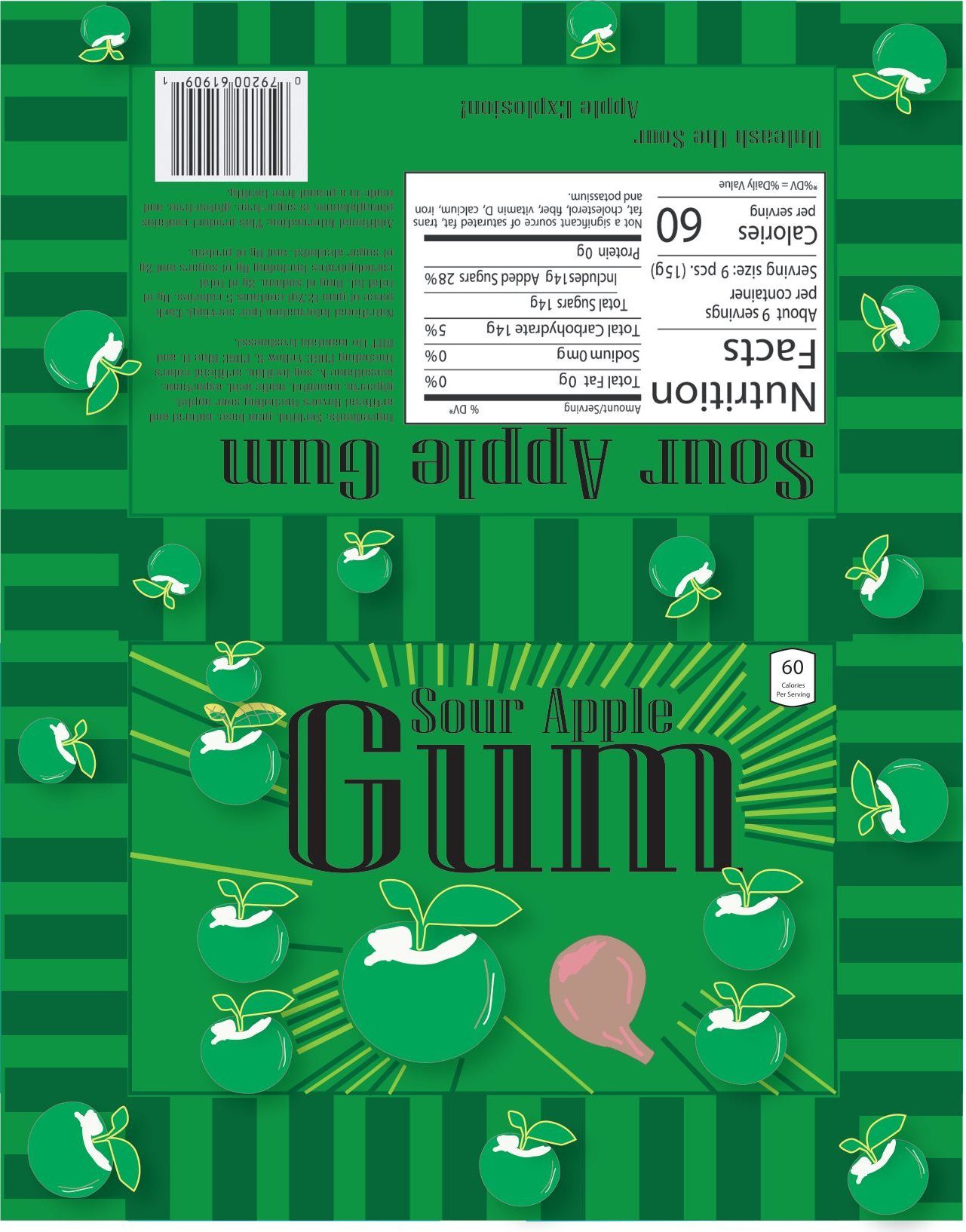
The wrapper above shows how fast this kind of text adds up. I made it as a class project in Graphic Design Basics at State College of Florida (SCF), and its complete back panel holds nutrition facts, serving information and a barcode. It's not a real product, not a cottage food label and not a compliance example. I show it for size only.
How do you test the label before printing a batch?
Print one first, then work through these checks:
- Print at actual size. Turn scaling off (Acrobat calls this setting Actual size). Shrinking the label to fit the page can drop the statement below 10 points, and so can resizing the artwork in your layout file.
- Stick it on the real container. Check that a curve or seam doesn't hide any words.
- Read every line in your hand. Use the actual label stock if you can.
- Compare it to the statute. Check the statement word for word, go through items (a) to (g), and compare the ingredients and allergens to your recipe.
- Fix the file, then print again.
Where can you check the current rules?
Read the current text of §500.80 directly. Under (1)(a), the exemption from food permitting under s. 500.12 applies only if annual gross sales of cottage food products don't exceed $250,000. Subsection (2) allows sales over the Internet or by mail order and bars sales or delivery at wholesale. It doesn't address customers in other states, so ask FDACS about that.
The FDACS cottage foods page links to the statute. As of November 4, 2026, that page had no sample label or checklist, so ask FDACS whether it has current guidance. For questions about your own label, contact the FDACS Division of Food Safety at 1-800-HELP-FLA (435-7352) or FoodSafety@FDACS.gov.
Want help with the layout?
Send your container size and every line of final text, as the design brief guide describes. My packaging design page shows the class-project wrapper. I'm a graphic designer in the Sarasota–Bradenton area and I also work remotely. Packaging or label design starts at $200 with a fixed quote up front, and the FAQ covers timing and the files you get back. Whether the wording meets the rules remains a question for FDACS.