
Article · Brandon Warrell
Full wrap, partial wrap or vinyl lettering: which vehicle design fits your business?
A full wrap covers the painted body and gives you the most room for imagery. A partial wrap covers part of the body and uses the paint color as part of the design. Cut-vinyl lettering carries your name, phone and web address in solid colors, with no photos or gradients. Choose by how much the vehicle has to say, whether its paint color helps your brand, and what the wrap shop quotes.
Should your vehicle get a full wrap, a partial wrap or vinyl lettering?
The table gives the short answer. These terms aren't used the same way everywhere, so ask your shop what each one includes.
| Option | What it covers | What it can show | Choose it when |
|---|---|---|---|
| Full wrap | The vehicle's whole surface, with some variation by shop | Photos, gradients and patterns | You want a complex design or imagery on the whole vehicle |
| Partial wrap | Some main areas, with paint showing | Printed graphics, with the paint as a color | The paint color works with your brand |
| Cut-vinyl lettering | Only the letters and simple shapes | Solid colors from a vector path | The name and contact details are enough |
Your shop's quote decides the cost.
My own example below is a full wrap, made as SCF coursework. The partial and lettering advice here is general guidance from wrap-film makers and sign shops.
What does a full wrap cover?
Avery Dennison's wrap FAQ says "A full wrap covers the entire surface of the car or vehicle." "Full" still varies. The same FAQ says "On most automobiles the roof is included", but "Generally roofs are not wrapped (vans, trucks or SUVs), unless it is requested by the customer." Ask what your shop's "full" includes.
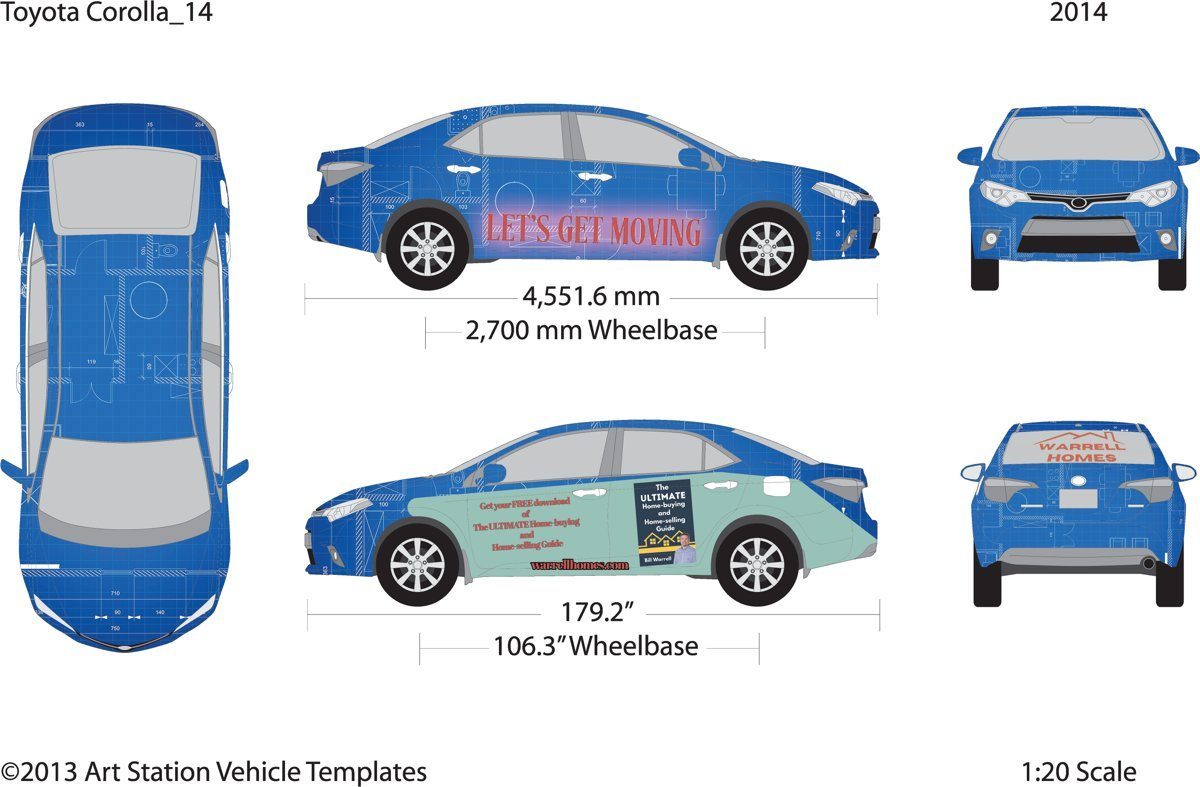
Here's how a full-wrap layout gets tightened. I designed a logo and a full company-car wrap for Warrell Homes, the real-estate business my dad ran, as SCF coursework (Photoshop, Spring 2025). The design wraps a blue Toyota Corolla on the driver side, passenger side, front, back and roof. An all-over blue pattern reaches every view, while the logo and "Let's Get Moving" sit on selected areas.
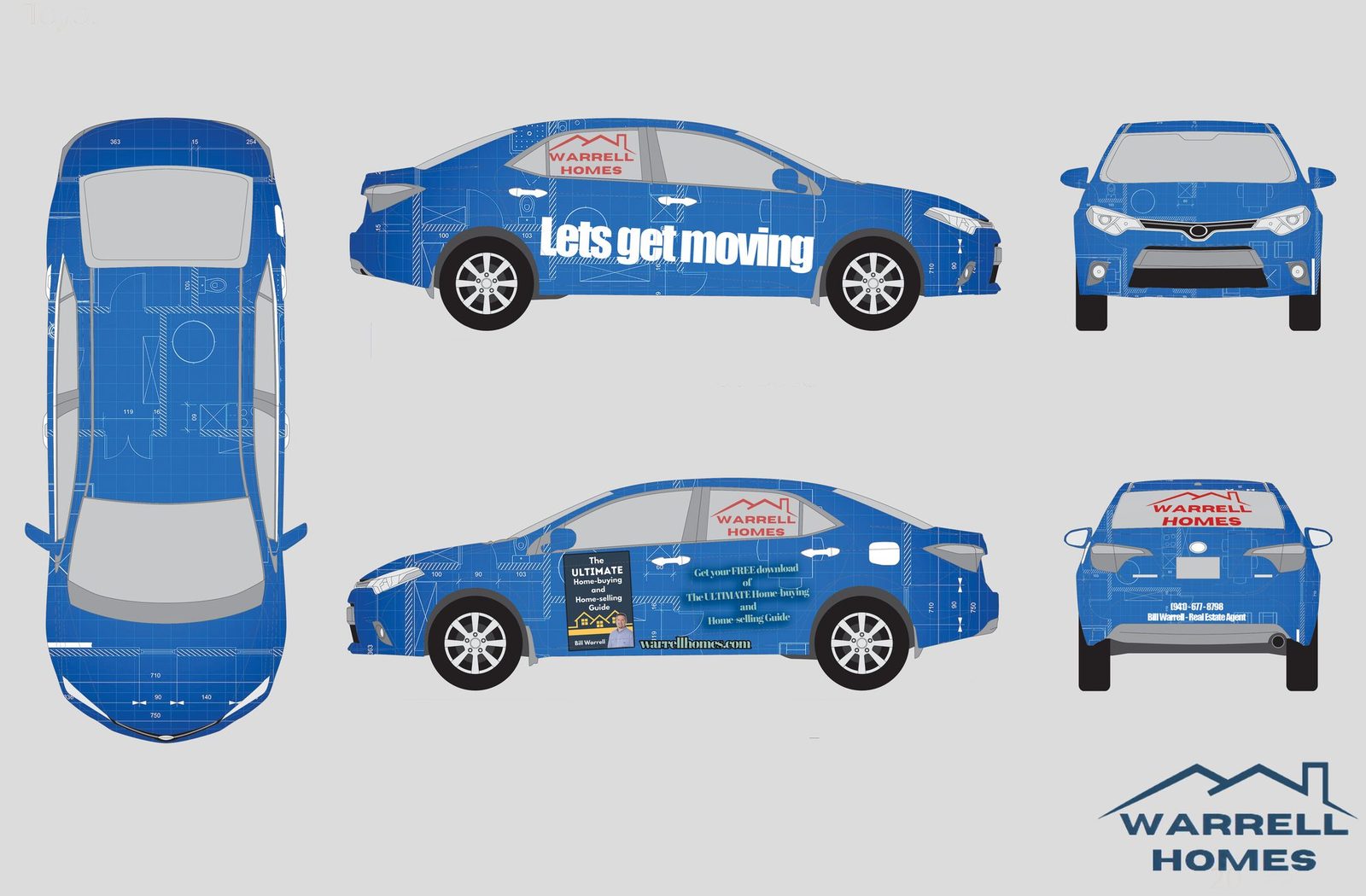
The critique draft had a white "Lets get moving" and already carried the home-buying guide offer, the guide cover and the website. The final has a red "LET'S GET MOVING" headline and a mint driver-side panel. The same car drawing now sits on a measured 1:20 template sheet that lists 4,551.6 mm overall and a 2,700 mm wheelbase. The design feedback article uses the same revision as an example of how a draft tightens after critique.
What is a partial wrap, and how does the paint color fit in?
A partial wrap covers some of the body and leaves the rest as paint. Avery Dennison's FAQ says it "uses the vehicle's paint scheme as the backdrop for the full design." Coverage varies: one SpeedPro shop says "anywhere from one-quarter to three-quarters of the car", focused on areas such as the hood, sides and trunk.
The design difference is that the paint becomes one of your colors, so the vehicle's color belongs in the first conversation. If printed vinyl has to meet the paint with no visible edge, ask your shop how close it can get, and check a printed swatch next to the vehicle. The vehicle wrap logo guide explains why screens mislead on color.
A partial layout can be built around a contained block of information. The mint panel on my final shows what that kind of block looks like, though it was made for a full wrap. It sits on the wrap rather than on paint, and it spans the door gap, so it isn't a model for placement.
When is cut-vinyl lettering enough?
Lettering is enough when people only need to know who you are and how to reach you, and your logo holds up in solid colors.
Signs.com cuts its lettering from solid colored vinyl, requires vector artwork for uploaded files and says "Text effects such as gradients, shadows, borders, slants, etc. are not possible with vinyl lettering." Its lettering with three or more colors comes as one layer per color. If your logo is only a PNG or JPG, it has to be traced first, which the logo file types guide covers.
My own vinyl cut-path work is on a Cricut, not on vehicles. For vehicle lettering, a sign or wrap shop can cut and install it.
What does each layout have to work around?
A full wrap meets all of this, a partial meets whatever its areas touch, and lettering only has to find clear spots.
- Door handles and lights: Wrap-film maker Arlon's design tips say to "maintain solid colors around door handles and lights".
- Door gaps and windows: Signs of the Times warns that "small letters become lost as they cross over window seams or doorjambs".
- Seams: The same article says installers prefer to seam between the quarter panel and the bumper. Ask your shop where its seams fall.
- Body lines: Arlon says to work with the vehicle's natural lines.
- Hood, front and back: Signs of the Times advises against patterned or linear graphics where the sides meet at the front, back and hood. My class wrap's top view runs its pattern over the hood and roof, and where a pattern meets the sides is what to check on a template.
- Windows: Graphics that continue across glass use perforated film, which Avery Dennison says shows the graphic on one side and allows viewing through from the other. Rules on window coverings vary by state. This isn't legal advice, so ask your shop or your state's motor vehicle agency.
The template is how you check all of this. A 2013 Signs of the Times how-to says templates come at 1/20 scale and to confirm their accuracy by measuring the actual vehicle. Mine is 1:20; check what your shop uses.
How much can each one say?
A full wrap can carry the most, a partial wrap only what fits in its wrapped area, and lettering the least.
- Full wrap: It has the most space, but more room doesn't give people more time to read. Use the extra room for imagery, not extra sentences.
- Partial wrap: The message lives inside the wrapped area, so keep it to what fits there at a readable size.
- Lettering: Your name, what you do, and a phone number, a web address or both, if they fit at a readable size.
Some sign shops borrow a billboard guideline of about seven words, covered in the logo guide. The offer on my class wrap runs past it.
What should you send your designer?
Start with the design brief checklist. For every option, send the year, make, model and body style, clear photos of every side, your final wording, and your shop's template and file specs if you've picked a shop. Then add:
- Full wrap: A vector logo, brand colors and full-size photos you have the right to use.
- Partial wrap: The same files, plus the paint color and any areas you know you want covered.
- Lettering: A vector logo with a one-color version, your colors and where each line should go.
I design wrap layouts and prepare the print files on a measured template of your exact vehicle, set up to the wrap shop's specs. A shop prints and installs, and I'm happy to work directly with the one you choose. See vehicle wrap design for the full class project. The FAQ lists a vehicle wrap layout from $300. It has no separate line for partial layouts or lettering, so ask me first whether I can take yours on and what it would cost.